Mastering the 3-Person Progressive Hose Lay
Mastering the 3-Person Progressive Hose Lay in Wildland Firefighting: Step-by-Step with Key Communications
THE FAST HOW-TO GUIDE
TEAM FAST
9/25/20253 min read
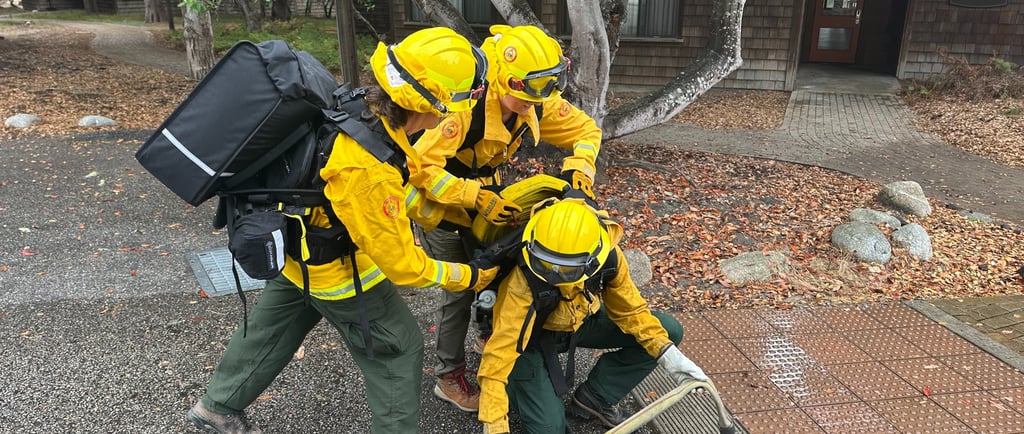
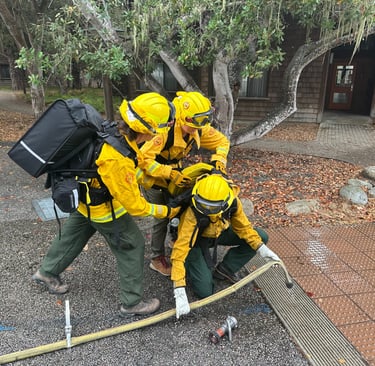
Mastering the 3-Person Progressive Hose Lay in Wildland Firefighting: Step-by-Step with Key Communications
Building on our previous guide to the progressive hose lay, let's level up to a 3-person team setup. This configuration is common in wildland operations for faster, more efficient deployment—especially on steeper terrain or longer lays where fatigue hits quick. The extra person adds a dedicated clamper (or backup/hose support role), reducing physical strain, improving safety, and speeding up connections.
In a typical 3-person progressive hose lay (often using 1.5-inch trunk line with pre-packed sections and 1-inch laterals via gated wyes), roles are:
- Nozzle Person (Nozzle/Lead): Advances the line, applies water, knocks down fire, creates the wet line.
- Hose Person (Hose/Backup): Manages slack, deploys the next pack from the nozzle person's back (or carries additional), handles couplings during extensions.
- Clamp Person (Clamper/Third): Deploys hose packs ahead, sets clamps to control flow/pressure, verbalizes connections, and supports overall advancement (sometimes carries extra tools or monitors LCES).
This follows patterns from training evolutions where the team maintains continuous water flow while extending the lay. Always start with a solid anchor point (e.g., road or black), establish LCES (Lookouts, Communications, Escape Routes, Safety Zones), and brief the team.
Preparation
- Full wildland PPE (Nomex, helmet, gloves, boots, eye pro).
- Pre-packed hose packs (e.g., Smokey packs: 100' 1.5" trunk + gated wye + reducer + 100' 1" lateral/nozzle).
- Hose clamps (at least 2–3), tools (Pulaski/McLeod for minor work).
- Radio on tactical channel; confirm freqs and backup verbal signals.
- Brief: "We're flanking from anchor, pinching head. LCES in place. Communications clear—use loud/concise calls. Switch roles mid-lay if needed for fatigue."
Step-by-Step Deployment Process (500–1,000 ft Lay Example)
Assume starting from engine discharge or existing trunk line. Nozzle starts with charged line + pack; Hose and Clamp carry packs/tools.
1. Initial Setup & Advance
- Nozzle connects nozzle to starter hose, charges line (call for water from engine/pump).
- Nozzle: "Water on! Bleed air... pattern good. Advancing from anchor."
- All advance into black/anchor, Nozzle knocks fire, creates wet line.
- Hose manages slack behind Nozzle (keeps ~10' slack).
- Clamp monitors rear, watches for kinks/flare-ups.
2. First Extension (When Nozzle's pack nearly empty)
- Hose (or Clamp) calls when ~10' usable hose left in current section.
- Hose/Clamper: "Hose! 10 feet!" (loud, repeated if noisy).
- Nozzle stops advancing but continues flowing/knocking fire ahead.
- Nozzle: "Copy—holding here, flowing."
- Clamp (or Hose) deploys next full pack from Nozzle's back or their own: stretches 1.5" trunk fully.
- Clamp: "Deploying next—hose out!" (as they lay it straight).
- Clamp sets hose clamp on charged line upstream.
- Clamp: "Clamped!"
3. Connection Sequence
- Nozzle opens bale slightly to relieve pressure.
- Nozzle: "Pressure off—handing female."
- Nozzle removes nozzle, hands female coupling to Hose/Clamper.
- Hose/Clamper hands male end of new section to Nozzle.
- Hose/Clamper: "Male to you."
- Nozzle attaches nozzle to new male.
- Nozzle: "Nozzle on—ready for water."
- Hose/Clamper connects female of new section to clamped coupling.
- Hose/Clamper: "Connected—ready to release clamp."
- Nozzle calls for flow.
- Nozzle: "Water coming!"
- Clamp/Hose slowly releases clamp.
- Clamp: "Clamp off—flow good."
4. Resume Advance
- Nozzle bleeds air, adjusts pattern.
- Nozzle: "Bleed complete—advancing."
- Team moves forward: Nozzle leads attack, Hose manages slack (~10'), Clamp deploys/monitors next pack or rear safety.
5. Repeat for Subsequent Extensions
- Repeat steps 2–4 for each new section (every ~100').
- Maintain continuous flow—never fully shut down unless emergency.
- Hose: "10 feet!" → triggers next clamp/deploy.
- Rotate roles mid-lay (e.g., after 200–300') to manage fatigue.
- All: "Switching—Nozzle to Hose, Hose to Clamp, Clamp to Nozzle." (quick verbal confirm).
6. Final Pinch & Secure
- Advance to pinch fire head (meet black or control line).
- Nozzle creates wide wet line, mops hotspots.
- Nozzle: "Pinching head—flowing wide."
- Clamp/Hose secure line, add laterals if needed (open wyes for mop-up).
- Clamp: "Line secure—laterals ready."
- Slowly shut down nozzle.
- Nozzle: "Nozzle closed—mop-up mode."
Key Communication Tips
Clear, loud, concise calls prevent mistakes in noisy/fire environments. Use standard phrases:
- Slack/Extension Trigger: "Hose!" or "10 feet!" (Hose/Clamper to Nozzle).
- Status Confirm: "Copy—holding/flowing." (Nozzle response).
- Clamp Actions: "Clamped!" / "Connected!" / "Clamp off—flow good." (Clamp/Hose).
- Pressure/Flow: "Pressure off" / "Water coming!" / "Bleed complete."
- Safety/Stop: "Stop—flare-up!" or "Escape route check!" (anyone).
- Role Switch: "Switching positions—confirm."
- Radio backups for IC: Use CAN reports (Conditions, Actions, Needs) e.g., "Anchor established, advancing 300 ft, water good."
Tips for Success & Safety
- Practice dry runs—3-person lays often complete faster than 2-person.
- Keep line in black to avoid burn-through.
- Monitor for kinks (cause pressure loss), fatigue, changing fire behavior.
- Add lookouts if visibility poor.
- Use wyes every 200' for laterals/mop-up.
This 3-person method boosts speed and safety—perfect for initial attack crews.
Sources
- Fire and Safety Training guide - https://fireandsafetytraining.com/learning-the-progressive-hose-lay
- Fresno City Fire Department Training Manual Section 316.035 (adapted for 3-person elements).
- Wildland Progressive Hose Lay videos (YouTube demos showing team roles/comms).
- Pendleton Fire Department Wildland Firefighting Chapter 12.0.
- NWCG S-130 Unit 10: Water Use (progressive lay advantages/process).
- Various wildland training resources (e.g., Rhode Island Forest Fire Program hose lay tactics, CAL FIRE demos).
List of Acronyms
- LCES: Lookouts, Communications, Escape Routes, Safety Zones
- NWCG: National Wildfire Coordinating Group
- PPE: Personal Protective Equipment