Download: NWCG S-190: Glossary of Terms


Download: NWCG Hand tools introduction
Download: NWCG S-130: Glossary of Terms
NWCG S-130: Hand Tools Introduction – Key Terms
This glossary focuses on the hand tools commonly introduced in the NWCG S-130 Firefighter Training course, particularly in the Tools and Equipment unit (often Unit 8 or Module 6 in various versions). It covers basic wildland firefighting hand tools used for fireline construction, suppression, mop-up, and related tasks.
Definitions and descriptions are adapted from official NWCG S-130 materials (e.g., instructor guides, student workbooks, PMS 461 IRPG references, and PMS 205 Glossary), emphasizing tool types, parts, uses, maintenance, and safety. These are foundational for FFT2 (Basic Wildland Firefighter) duties.
For the most current details, refer to official NWCG resources: https://www.nwcg.gov/publications/pms461 (IRPG) and https://training.nwcg.gov/courses/s130 (S-130 materials).
Cutting Tools
These tools are primarily used for chopping, grubbing, trenching, cutting brush/small trees, and removing ground cover during fireline construction.
- Axe (Single-Bit or Double-Bit): A chopping tool with a sharp blade on one side (single-bit) or both sides (double-bit). Used for felling snags, chopping stumps/logs, driving wedges, and mop-up operations. Sharpen by grinding or filing on an even taper; inspect for cracks/gouges in head.
- Pulaski: A versatile combination tool with an axe blade on one side and an adze (grubbing/hoe-like) edge on the other. Ideal for cutting brush/roots and digging/trenching in fireline work. Sharpen both edges carefully; check for secure head attachment.
- Brush Hook: A curved, J-shaped blade tool designed for slashing through heavy brush, vines, or small saplings. Lightweight and effective in dense fuels; maintain sharp edge for efficiency.
- Sandvik (or similar lightweight cutter): A very lightweight cutting tool for clearing light brush or undergrowth. Used where portability is key; sharpen blade as needed.
Scraping Tools
These tools are suited for constructing fireline (scraping to mineral soil), raking, trenching, grubbing, throwing dirt, and mop-up.
- Shovel (Round-Point): A digging/scraping tool with a pointed blade for throwing dirt, digging trenches, or turning soil to expose mineral earth. Proper grip/stance important for safety; maintain sharp edge and straight handle.
- McLeod: A rake-hoe combination tool with a hoe blade on one side for grubbing/cutting sod and rake teeth on the other for raking/trenching. Excellent for finishing fireline to mineral soil; keep teeth straight and edges sharp.
- Fire Rake (Council Tool/Rake): A rake with sturdy tines for constructing fireline in light fuels like deciduous leaves or grasses. Used for raking duff/needles to bare soil; maintain tines alignment.
- Hoe (Adz Hoe or similar): A grubbing tool with a wide blade for digging through rocky or hard soil, chopping roots, or scraping. Effective in tough ground cover; sharpen blade regularly.
- Wire Broom: A broom-like tool with wire bristles for sweeping away light grasses, pine needles, or fine fuels. Used in mop-up or light fuel clearing; replace bristles when worn.
Other Hand Tools and Related Terms
- Fire Swatter (or Fire Flapper): A rubber or fabric flap on a pole used to beat out flames in light fuels (e.g., grass fires). Check for tears/holes; perform field maintenance by cleaning and securing flap.
- Combi Tool (Combination Tool): A multi-purpose tool (often rake-hoe hybrid) for various scraping/cutting tasks in fireline work. Versatile in mixed fuels; maintain both sides.
- Hand Tool Care / Maintenance: General practices include field sharpening (file or grinder), inspecting for cracks/rust/damage, proper storage (sheaths when possible), and identifying tools needing replacement (e.g., loose heads, bent handles).
- Carrying Hand Tools: Safe methods include carrying over shoulder with blade away from body, or parallel to ground when passing; never run with tools.
- Using Hand Tools: Maintain proper spacing (e.g., 10 feet between workers), use correct grip/stance to avoid injury, and place tools safely (blade down, out of walkways) when not in use.
- Tool Order: Strategic arrangement of tools (e.g., saws followed by cutters, scrapers) for efficient, safe handline construction.
- Spacing: Safe distance between crew members during tool use to prevent accidents (typically 10+ feet).
This covers the primary hand tools and concepts emphasized in the S-130 hand tools introduction/overview (e.g., identification, selection by fuel/ground type, safe handling, maintenance, and field use).
disclaimer: This material is adapted from NWCG S-130 course materials, PMS 461 (IRPG), and PMS 205 for educational purposes. Always use official NWCG sources for training and field reference.
NWCG S-130: Glossary of Terms
This glossary compiles key terms commonly referenced or introduced in the NWCG S-130 Firefighter Training course (basic wildland firefighter skills, including fire behavior, suppression, tools, safety, and operations). Definitions are drawn from the official NWCG Glossary of Wildland Fire, PMS 205 (the authoritative source used throughout S-130 materials) and course-specific content (e.g., from student workbooks, instructor guides, and IRPG references).
These terms focus on foundational concepts for entry-level firefighters (FFT2/FFT1). For the full, up-to-date glossary (over 2,400 terms), visit the official NWCG site: https://www.nwcg.gov/glossary
Parts of a Fire
- Origin: The location where the fire started.
- Head: The most active part of the fire, showing the main direction of spread; usually the hottest and fastest-moving section.
- Flank (Right and Left): The sides of the fire, parallel to the main direction of spread; may have active fire but less intense than the head.
- Rear/Heel: The back of the fire, opposite the head; burns less vigorously, often near the origin.
- Perimeter: The boundary or edge of the fire (also called fire edge); may not always have active flame.
- Finger: A narrow strip of fire projecting away from the main body; can flank firefighters if not monitored.
- Pocket: An unburned area between the main fire and fingers.
- Island: An unburned area of fuel completely surrounded by the fire perimeter.
- Spot Fire: A fire started outside the main perimeter, often by embers, sparks, or rolling debris.
Fire Behavior Terms
- Spread / Rate of Spread (ROS): The movement or forward progress of the fire, often measured in chains per hour (1 chain = 66 feet).
- Smoldering: Fire burning without visible flame, spreading very slowly.
- Creeping: Slow-spreading fire with low flames.
- Running: Rapid spread with a well-defined head.
- Backing: Fire spreading against the wind or downhill, away from the head.
- Spotting: Embers or sparks carried ahead of the main fire by wind or convection, starting new fires.
- Torching: Surface fire igniting individual tree/shrub crowns temporarily before dropping back to the surface.
- Crowning: Fire advancing through tree/shrub canopies, largely independent of surface fire; high intensity and dangerous.
- Blowup: Sudden, dramatic increase in fire intensity or spread, often precluding direct attack.
Other Key Firefighting Terms (Common in S-130)
- Control Line: Any barrier (natural or constructed) that stops fire spread; includes fireline, roads, streams, etc.
- Fireline: A constructed break (usually scraped to mineral soil) to halt fire advance.
- LCES: Lookouts, Communications, Escape Routes, Safety Zones — the standard safety system for fireline work.
- Standard Firefighting Orders: 10 fundamental rules for safe operations (e.g., fight fire aggressively but provide for safety first).
- Watch Out Situations: 18 common hazards or conditions that require extra caution.
- Burn Out: Setting fire inside a control line to consume fuel between the edge and the main fire.
- Jackpot Burning: Deliberate burning of concentrated fuel pockets in prescribed fire.
- Bone Piling: Stacking large fuels inside the control line for faster consumption.
- Mop-up: Extinguishing all hot spots after containment to prevent re-ignition.
- PPE (Personal Protective Equipment): Required gear including Nomex shirt/pants, hard hat, gloves, boots, eye protection, etc.
- IRPG (Incident Response Pocket Guide, PMS 461): Primary field reference for S-130 students and FFT2s.
- Handline: Fireline constructed by hand tools (e.g., Pulaski, shovel, McLeod).
- Anchor Point: Secure starting point for fireline construction to prevent flanks from cutting off crews.
- Indirect Attack: Building line away from the fire edge and burning out toward it.
- Direct Attack: Building line along or very close to the fire's edge.
This list covers the core terminology emphasized in S-130 units (e.g., basic fire behavior in intro modules, tools/equipment, suppression techniques, firing devices, water use, WUI, and safety). Disclaimer: Definitions adapted from NWCG PMS 205 and S-130 course materials for educational purposes. Always refer to official NWCG sources for the latest versions.
NWCG S-190: Glossary of Terms
This glossary compiles key terms commonly referenced or introduced in the NWCG S-190 Introduction to Wildland Fire Behavior course (focusing on the primary factors affecting wildfire start, spread, and behavior: fuels, weather, topography, and safety indicators). Definitions are adapted from official NWCG sources, including the NWCG Glossary of Wildland Fire, PMS 205, S-190 student workbook, instructor guides, and related materials (e.g., IRPG references).
The course emphasizes foundational fire behavior concepts for entry-level wildland firefighters (often paired with S-130). For the complete, up-to-date glossary (thousands of terms), visit the official NWCG site: https://www.nwcg.gov/glossary.
Parts of a Fire
- Point of Origin: The precise location where a competent ignition source came into contact with the material first ignited and sustained combustion occurred.
- Perimeter: The entire outer edge or boundary of a fire.
- Head: The side of the fire having the fastest rate of spread; usually the most active and intense part.
- Flank (Right and Left): The parts of a fire's perimeter roughly parallel to the main direction of spread.
- Rear / Heel: The portion of a fire spreading directly into the wind or downslope; opposite the head and typically the slowest-spreading part.
- Finger: A narrow strip of fire projecting from the main body.
- Pocket: An unburned area enclosed on three sides by fire.
- Island: An unburned area completely surrounded by fire.
- Spot Fire: A fire started beyond the main fire perimeter by embers or sparks.
Fire Behavior Terms
- Smoldering: Fire burning without visible flame and barely spreading.
- Creeping: Fire burning with a low flame and spreading slowly.
- Running: Behavior of a fire spreading rapidly with a well-defined head.
- Spotting: Behavior of a fire producing sparks or embers carried by wind, starting new fires beyond the zone of direct ignition.
- Torching: Surface fire igniting single or small groups of tree crowns without spreading to other crowns.
- Crowning: Fire advancing from top to top through tree or shrub canopies, largely independent of surface fire.
- Blowup: Sudden, dramatic increase in fire intensity or rate of spread.
Fire Triangle and Heat Transfer
- Fire Triangle: The three elements required for fire: fuel, heat (ignition source), and oxygen.
- Conduction: Transfer of heat through direct contact (e.g., from hot metal to fuel).
- Convection: Transfer of heat by movement of heated air or gases (e.g., rising hot air carrying embers).
- Radiation: Transfer of heat through electromagnetic waves (e.g., heat felt from flames without contact or air movement).
Fuels and Fuel-Related Terms
- Fuel: Any combustible material, especially wildland vegetation (live or dead plant material) or artificial fuels.
- Fuel Type: An identifiable association of fuel elements (species, form, size, arrangement) causing predictable rate of spread or resistance to control under specified conditions.
- Fuel Characteristics: Factors like loading (amount), size/continuity, moisture content, arrangement (e.g., ladder fuels connecting surface to canopy), compactness, and chemistry that influence fire behavior.
Weather and Atmospheric Terms
- Atmospheric Stability: Degree to which vertical motion in the atmosphere is enhanced (unstable) or suppressed (stable); affects fire intensity and spread.
- Stable Indicators: Layered clouds, smoke drifting apart horizontally, poor visibility from haze/fog, steady winds.
- Unstable Indicators: Cumulus clouds building vertically, good visibility, gusty winds, smoke rising high then spreading.
- Critical Fire Weather: Conditions (e.g., low humidity, high winds, dry fuels) that, combined with receptive fuels, may result in extreme fire behavior.
Topography and Alignment
- Topography: Terrain features (slope, aspect, elevation, shape) influencing fire behavior (e.g., steeper slopes accelerate uphill spread).
- Alignment: When fuels, weather (e.g., wind), and topography align to increase fire spread potential (e.g., upslope + wind direction).
Suppression and Safety Terms (Common in S-190 Context)
- Anchor Point: An advantageous location (barrier to fire spread) from which to start constructing a fireline to avoid being flanked.
- Control Line: All constructed or natural barriers and treated fire edges used to contain a fire.
- Fireline: The part of a control line scraped or dug to mineral soil.
- Mop-up: Extinguishing or removing burning material near control lines to prevent re-ignition.
- Contained: Control line completed around the fire and expected spot fires, reasonably expected to stop spread.
- Controlled: Control line around fire, spot fires, and interior islands; burnout and cooldown completed.
- Chain: A unit of measure (66 feet / 20 meters) used for fireline production or spread rates.
This list focuses on core terminology emphasized in S-190 units (e.g., basic concepts, fuels, weather/topography influences, critical factors, and alignment for extreme behavior).
Disclaimer: Definitions adapted from NWCG PMS 205, S-190 course materials, and related resources for educational purposes. Always consult official NWCG sources for the most current information.
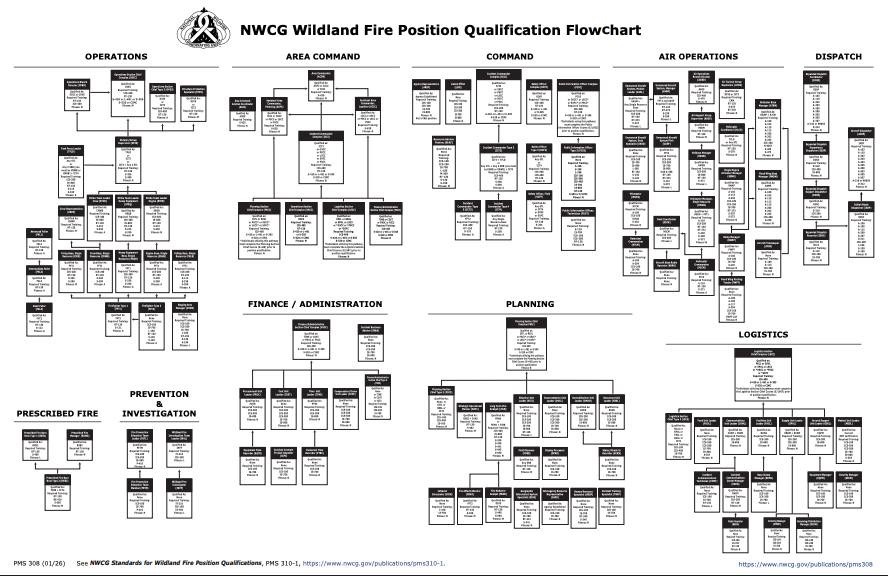
2026 Update to NWCG Standards for Wildland Fire Position Qualifications (PMS 310-1)
The National Wildfire Coordinating Group Incident and Position Standards Committee has released updates to the NWCG Standards for Wildland Fire Position Qualifications, PMS 310-1