Understanding Wildland Water Pumps
Understanding Wildland Water Pumps: How They Work and Why They Matter
THE FAST HOW-TO GUIDE
Jon Gustafson
3/10/20264 min read
Understanding Wildland Water Pumps: How They Work and Why They Matter
Water pumps are essential tools for delivering suppression water where it's needed most. Whether mounted on a Type 3 engine for pump-and-roll operations or used as portable units in remote areas, these pumps enable firefighters to combat brush fires, protect structures, and support mop-up efforts. This article explains the basics of wildland water pumps, focusing on centrifugal types (the most common in wildland applications), their key components, and how they operate. Knowledge of these systems enhances safety, efficiency, and effectiveness during operations.
Wildland pumps differ from structural fire pumps: they prioritize high pressure for long hose lays, mobility in rough terrain, and often include features like foam proportioning or ultra-high-pressure (UHP) capabilities for better water efficiency.
Types of Wildland Water Pumps
Wildland firefighting uses several pump categories, but centrifugal pumps dominate due to their reliability and performance.
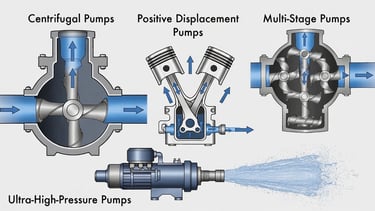
- Centrifugal Pumps — The standard for most wildland engines and portable units. They use spinning impellers to create pressure via centrifugal force.
- Positive Displacement Pumps — Less common in modern wildland setups but used in some older or specialized portable models (e.g., piston types). They capture and push fixed volumes of water.
- Multi-Stage Pumps — Found in high-pressure wildland applications (e.g., Darley, Hale, or WATERAX models), these stack impellers for higher PSI output, ideal for extended hose distances.
- Ultra-High-Pressure (UHP) Pumps — Emerging tech operating at 1,000+ PSI, producing fine mist for rapid heat absorption with less water—great for initial attack in Southern California's chaparral.
Portable pumps (e.g., lightweight or heavy-duty like the Mark-3) are engine-driven and often used with suction hoses from static sources like streams or tanks.
Key Components of a Wildland Centrifugal Pump
A typical wildland centrifugal pump (vehicle-mounted or portable) includes:
- Impeller(s) — The spinning heart of the pump. Water enters the center (eye) and is flung outward by rotation, converting kinetic energy to pressure.
- Pump Housing/Volute — Encloses the impeller, directing water to the discharge.
- Shaft and Bearings — Connect the engine/power source to the impeller; bearings reduce friction.
- Seals — Prevent leaks; mechanical seals are common.
- Primer — Essential for centrifugal pumps, which aren't self-priming. Electric, hand, or exhaust primers fill the pump with water to start suction.
- Intake/Suction Port — Connects to hose or tank; includes strainers to prevent debris.
- Discharge Ports — Outlets for hose lines, often with valves and gauges.
- Power Source — Diesel auxiliary engine, PTO (power take-off) from the truck engine, or electric in some setups.
- Gauges and Controls — Pressure gauges, throttles, relief valves to prevent over-pressurization.
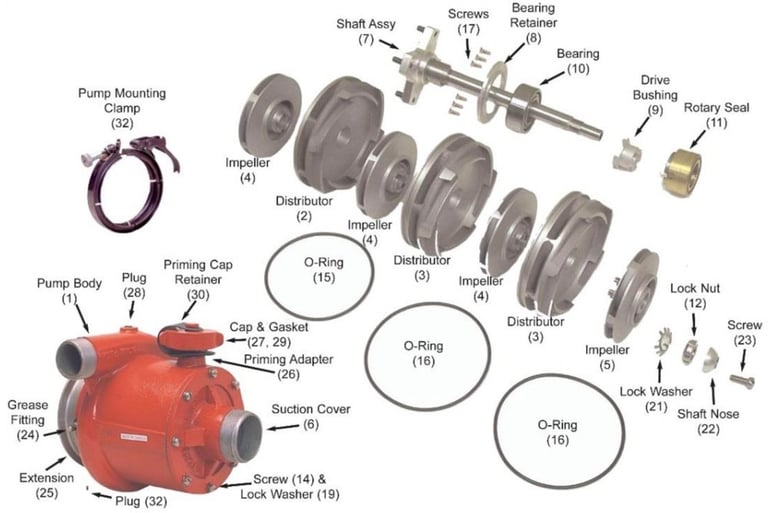
For multi-stage pumps, multiple impellers are stacked to boost pressure progressively.
This diagram of a multi-stage centrifugal pump (e.g., similar to WICK® FSP4200 models) shows the layered impellers, distributors, shaft assembly, and housing—illustrating how water flows through stages for increased pressure.
How a Wildland Centrifugal Pump Works: Step-by-Step
Centrifugal pumps rely on the principle of centrifugal force: spinning motion pushes water outward, building velocity and pressure.
1. Priming the Pump
Centrifugal pumps must be filled with water before operation (they can't pump air effectively).
- A primer (electric or hand) creates vacuum to draw water from the source into the pump housing.
- Once primed, the pump can maintain suction from a lift (up to ~10-20 feet, depending on model).
2. Water Intake
Water enters the suction inlet and flows to the center (eye) of the impeller.
3. Impeller Action
The engine spins the impeller at high RPM.
Water is accelerated radially outward by centrifugal force, gaining speed and kinetic energy.
As water moves to the impeller's edge, it enters the volute (spiral casing), where velocity converts to pressure.
4. Pressure Build-Up and Discharge
Pressurized water exits through the discharge port at high velocity and pressure.
In multi-stage pumps, water passes to the next impeller for further pressure increase.
Output: e.g., 150 GPM at 250 PSI on a Type 3 engine, or higher PSI for UHP systems.
5. Pressure Regulation
Relief valves or governors prevent damage from dead-heading (closed lines).
Throttle controls engine speed to adjust flow/pressure.
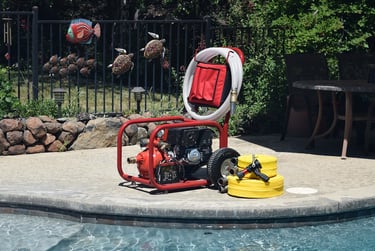
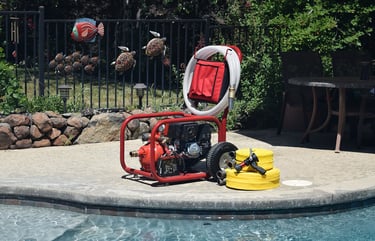
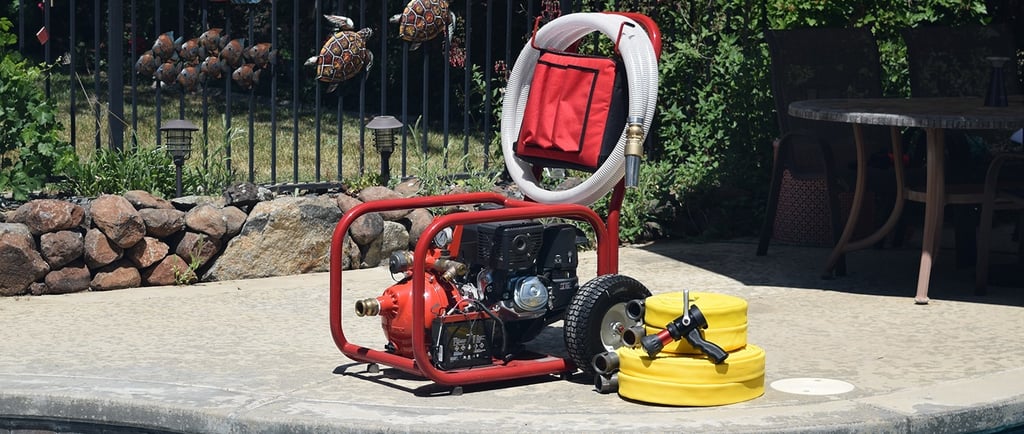
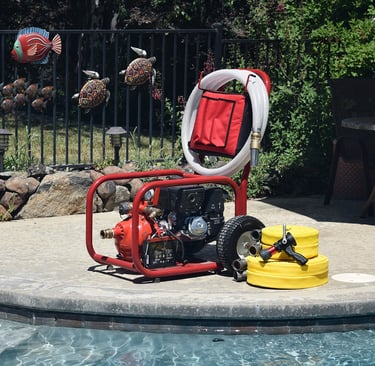
A portable wildland pump setup in action—note the compact engine, suction hose, and discharge reel—ideal for drafting from a pool or stream in remote Southern California canyons.
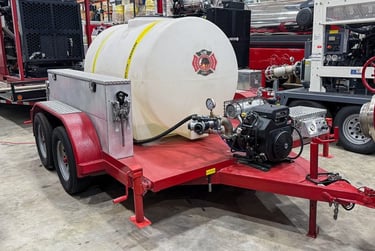
Trailer-mounted wildland pump units provide mobility for extended operations, with onboard tanks and high-pressure capabilities.
Safety and Operational Tips for Firefighters
- Avoid Cavitation — Caused by restricted suction (e.g., kinked hose, debris); signs include rattling and loss of pressure—reduce throttle or clear intake.
- Prime Quickly — Start pumping immediately after priming to avoid dry-running damage.
- Monitor Gauges — Watch for overheating or low oil; use pressure relief during pump-and-roll.
- Foam Integration — Many systems include proportioners for Class A foam—enhances penetration in dry fuels common in SoCal.
- Maintenance — Flush after use (especially saltwater drafting), check seals/bearings, and winterize lines to prevent freezing.
Understanding pump mechanics empowers operators to troubleshoot issues quickly—critical when seconds count.
For hands-on training, refer to NWCG courses like S-211 (Portable Pumps and Water Use) or agency-specific engine operator programs.