Beyond the Hundredth Meridian
Beyond the Hundredth Meridian: A Tale of Exploration, Warning, and Why Every New Wildland Firefighter Should Read Wallace Stegner’s Classic
BOOKS
Jon Gustafson
3/16/20266 min read
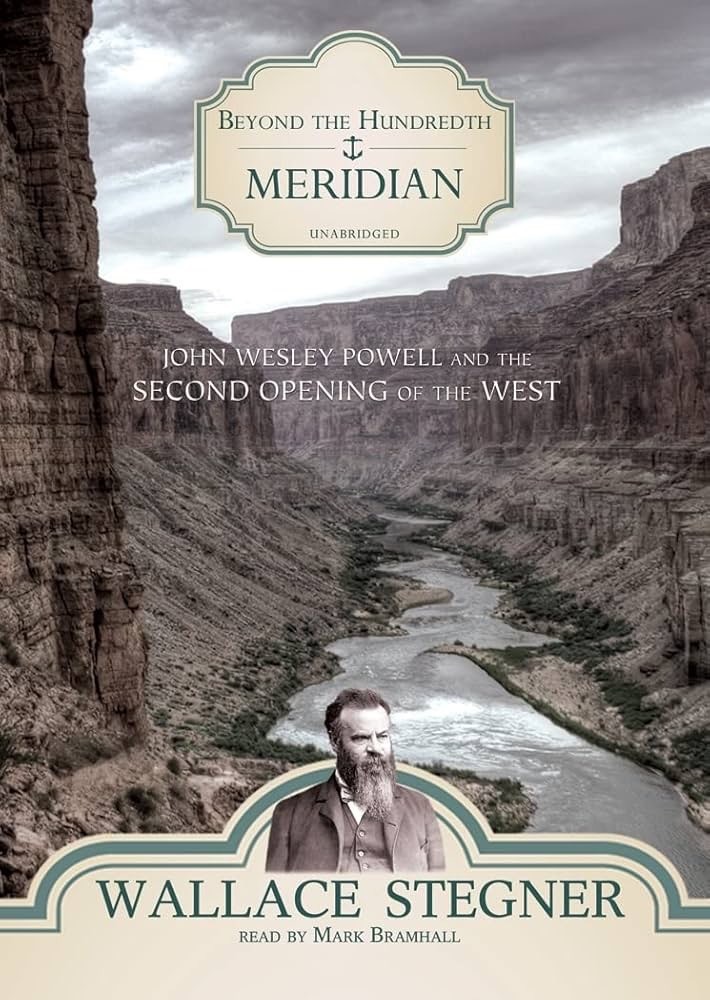
Beyond the Hundredth Meridian: A Gripping Tale of Exploration, Warning, and Why Every New Wildland Firefighter Should Read Wallace Stegner’s Classic
Imagine standing on a lonely stretch of prairie in the middle of the United States, roughly along today’s North Dakota–South Dakota border, extending south through Nebraska, Kansas, Oklahoma, and into Texas. To your east: green fields, reliable rain, farms that look like they belong in the Midwest. To your west: brown grasses, dusty soil, canyons, and vast emptiness where rain is scarce. That invisible line is the 100th meridian—the historic dividing line between the humid East and the arid West that John Wesley Powell first mapped in the 1870s.
Wallace Stegner’s 1954 masterpiece Beyond the Hundredth Meridian: John Wesley Powell and the Second Opening of the West isn’t just a history book. It’s an adventure story, a cautionary tale, and a scientific prophecy rolled into one. If you’re a rookie wildland firefighter—maybe fresh out of S-130/S-190, hauling your first line pack, or staring at your first Type 3 engine assignment in the Great Basin—this book will change how you see every fire you fight. It explains why the West burns the way it does, and it gives you tools to think like the scientists and explorers who came before you.
The Man Who Lost an Arm but Found a Continent
John Wesley Powell wasn’t your typical explorer. A Civil War veteran, he lost his right arm at the Battle of Shiloh in 1862. Most men would have retired. Powell grabbed a boat and, in 1869, led a ragtag crew of nine down the wild Colorado River through the Grand Canyon—without maps, with wooden boats, and with one guy steering with his left hand.
Stegner turns those river runs into edge-of-your-seat reading. You feel the boats smashing through Lava Falls, the crew starving, the one-armed major climbing canyon walls to take barometric readings. Powell’s second expedition in 1871–72 added science: geology, ethnology (he lived with and studied Native tribes), and the first serious mapping of the Colorado Plateau.
But the real bombshell came in Powell’s 1878 Report on the Lands of the Arid Region. He drew the 100th meridian and declared: west of this line, annual rainfall drops below 20 inches. Traditional Eastern-style farming would fail. The West could only support settlement through careful irrigation districts, scientific land classification, and respect for the land’s limits. He wasn’t anti-progress—he was pro-reality.
Washington politicians hated it. They wanted to keep the myth alive: “Rain follows the plow,” free homesteads everywhere, endless opportunity. Powell spent the rest of his career fighting bureaucrats, losing funding, and watching his vision get watered down. Yet his ideas eventually shaped the U.S. Geological Survey, the Bureau of Reclamation, and modern conservation.
Stegner writes with the beauty of a novelist (he later won the Pulitzer for Angle of Repose) but the rigor of a historian. You’ll close the book feeling like you just ran the Colorado with Powell—exhausted, awed, and wiser.
Why This 70-Year-Old Book Still Matters for Today’s Wildland Fire World
Powell’s meridian wasn’t just a line on a map. It explained the West’s natural fire regime long before anyone talked about “fire ecology.”
West of the meridian: sparse vegetation, low humidity, high winds, lightning-rich summers. Fuels dry out fast. Grasses and shrubs become tinder. Timber stands get stressed. Fires burn hot, fast, and big—exactly the landscape you’ll patrol on your first assignment in Montana, Idaho, or Nevada.
Fast-forward to 2026. Climate change has shoved that dry line eastward—some scientists say 140 miles or more toward the 98th meridian. Places that used to get enough rain now face longer droughts. Texas, once safely “east,” now deals with monster fire seasons. California’s Sierra Nevada and the Southwest see fire seasons that start earlier and end later. The arid West Powell warned about is expanding, and fire is expanding with it.
Stegner shows how ignoring Powell’s science led to over-settlement, fuel buildup, and the “fire suppression paradox” we still fight today. We put out every fire for a century, fuels piled up, and now we get megafires that laugh at hand crews. Powell would have recognized the pattern: treat the land like it’s unlimited, and nature pushes back—hard.
Firefighter Takeaways: Powell’s Lessons You Can Use on Your Next Shift
1. Know Your Fuels Like Powell Knew His Rocks
The 100th meridian marks where fine fuels (1-hour and 10-hour) dominate. Grass and brush dry to 5–10% moisture in hours under low RH. Learn to read NFDRS (National Fire Danger Rating System) charts the way Powell read barometers. If you’re in “beyond the meridian” country and RH drops below 15% with winds >15 mph, expect rapid spread. Spot fires will outrun you.
2. Drought Is the New Normal—Watch It Like a Scientist
Powell’s expeditions happened during dry years. Today’s extended droughts (exacerbated by climate shift) mean live fuel moistures in shrubs can crash below 60%. For beginners: always ask for the latest drought monitor map and live fuel moisture samples at briefing. A “normal” summer in the West is now Powell’s worst-case scenario.
3. Terrain Matters—Grand Canyon Style
Powell’s country is your country: steep canyons, narrow drainages, one-way-in/one-way-out roads. Remember LCES (Lookouts, Communications, Escape Routes, Safety Zones) was basically invented for this landscape. If your escape route is uphill through brush that hasn’t seen rain since last winter, you’re living Powell’s warning.
4. Prescribed Fire Is Powell’s Vision in Action
One ironic historical note: there was a time when prescribed burning was restricted west of the meridian because of political pressure. Today we know better. As a rookie, volunteer for a prescribed burn detail if you can. It’s the closest thing we have to resetting the clock on fuel loads Powell would have approved.
5. Think Long-Term, Fight Short-Term
Powell lost political battles but won the war of ideas. You’ll lose some fires—every firefighter does. But every time you push for better prevention, more prescribed fire, or honest conversations about wildland-urban interface growth in dry country, you’re carrying his torch. The West isn’t “broken”—it’s arid by design. Respect that design and you’ll go home safe more often.
Tying It All Together: How S-190 Brings Powell’s Meridian to Wildland Fire
If Beyond the Hundredth Meridian gives you the historical and geographical “why” behind Western fire behavior, then S-190: Introduction to Wildland Fire Behavior (the NWCG entry-level course you likely just completed or are about to take alongside S-130) gives you the practical “how” to apply it every shift.
S-190 is built around the three pillars of the wildland fire environment—fuels, weather, and topography—and how their interactions drive fire start, spread, and intensity. You learn the fire triangle (fuel, oxygen, heat), basic terminology (head, flank, heel, perimeter, point of origin), heat transfer methods, and the critical alignment of those three factors that can turn a routine grass fire into extreme behavior.
Key connections to Powell’s world:
- Fuels — In arid regions west of the 100th meridian, fine, flashy fuels (grass, chaparral, pine needles) dominate and dry quickly due to chronic low precipitation. S-190 teaches you to recognize fuel models, moisture timelags (1-hour, 10-hour, 100-hour), and how sparse, receptive fuels lead to high rates of spread—exactly the conditions Powell mapped as limiting traditional settlement.
- Weather — Low RH, high temps, unstable air, critical fire weather (pre-frontal hot/dry winds, foehn effects) — these are amplified in the dry West. S-190 covers indicators like smoke behavior, cloud types, and stability to spot when fire behavior will escalate.
- Topography — Steep slopes, south-facing aspects (hotter, drier fuels), narrow canyons channeling winds—these features Powell explored in the Colorado Plateau make fires run uphill faster, create spotting over ridges, and trap crews. S-190 drills recognition of alignment: when slope, aspect, and wind push fire upslope in dry fuels, extreme behavior follows.
- Extreme Fire Behavior & Safety — The course emphasizes spotting problem indicators (crowning, torching, spotting, fire whirls) and how alignment of fuels-weather-topography creates blow-ups. In Powell’s arid zone, this alignment happens more readily and more often—S-190 equips you to anticipate it and apply the 10 & 18 orders, LCES, and IRPG guidelines to stay alive.
S-190 is the foundational lens every firefighter uses to read the landscape Powell first warned us about. When you’re on a briefing looking at a red-flag day in Nevada sagebrush or California chaparral, you’re seeing the 100th meridian’s legacy in real time. Stegner’s book provides the deep historical context; S-190 gives you the immediate tools to act on it safely.
Final Thoughts:
Beyond the Hundredth Meridian isn’t required reading in fire academy, but it should be—especially right after you finish S-190. Stegner gives you the big-picture story behind every red-flag warning, every lightning-caused start, and every evening when the humidity refuses to recover. Powell’s one-armed determination reminds you that real leadership in wildland fire is about science, humility, and telling uncomfortable truths. S-190 turns that wisdom into actionable knowledge so you can predict, mitigate, and survive what the arid West throws at you.
Lasty, I would like to thank Lisa Andreano for the inspiration for this story. Lisa is a recognized firefighter associated with California State Parks and the National Wildfire Coordinating Group (NWCG). She is noted for her work in wildfire management and will incorporate books like this into her classroom instruction.
You can also check out this story on Lisa and others making an impact on our cherished landscape